
CAM Toolpaths
Pocket & Adaptive Clearing Toolpath
Clear recessed trays, mortises, and sign backgrounds using Offset, Raster, or Adaptive/Trochoidal clearing with automatic multi-tool rest machining.
The Pocket toolpath removes all stock inside closed vectors down to your chosen Cut Depth. When vectors are nested inside one another (such as raised text inside a sign border), VibeCNC automatically leaves the inner shapes standing proud as islands.
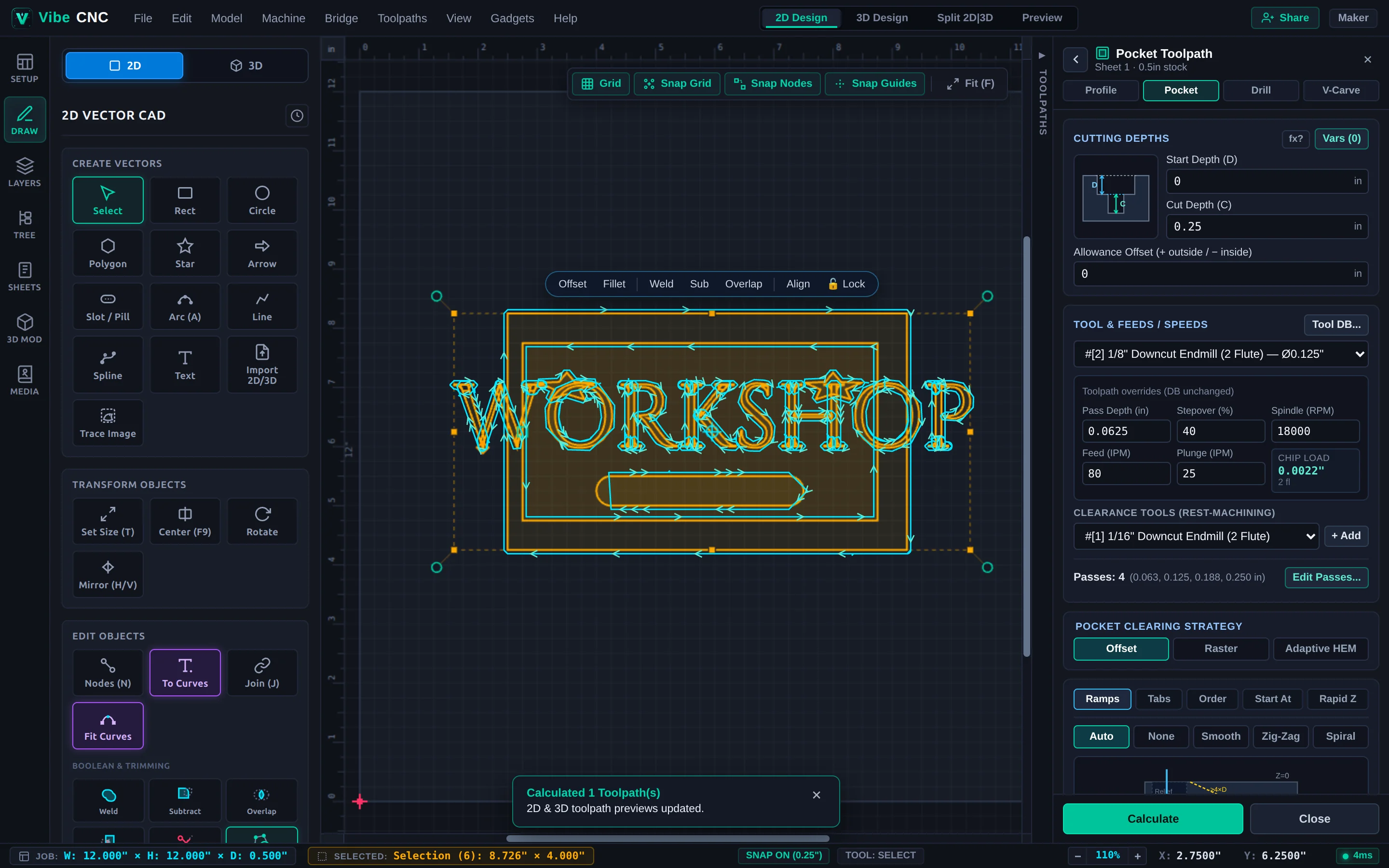
Comparing Clearing Strategies
| Strategy | Tool Motion | Best Used For |
|---|---|---|
| Offset (Inside-Out) | Concentric rings expanding from center outward. | Curved trays, round pockets, sign backgrounds. Every outer ring enters laterally from the cleared center with zero Z plunges. |
| Raster | Parallel back-and-forth passes at a chosen angle. | Rectangular dadoes, wood panels where matching grain direction (0 or 90 deg) minimizes fuzz. Always enable Profile Pass (Last) for clean walls. |
| Adaptive / Trochoidal | Constant-engagement curved loops that avoid sudden corner load spikes. | Deep pockets in aluminum, dense exotic hardwoods, and fragile 1/8" or 1/16" end mills. |
Multi-Tool Clearance (Rest Machining)
Adding two or more tools to a single Pocket operation (ordered largest to smallest, such as 1/4" Downcut + 1/8" Downcut) gives you the best of both speed and corner sharpness:
- VibeCNC generates
Pocket 1 [Clear 1]for the large bit to hog out bulk waste quickly. - The smaller finish tool computes true rest-machining paths against the 2.5D stock model, cutting only the narrow channels and tight corners the large bit could not fit into, with zero air-cutting.
Tips for Glass-Smooth Pocket Floors
- Set Stepover to
35% to 45%for flat end mills (tighter stepovers reduce subtle floor ridges if your spindle is slightly out of tram). - Set a Last Pass Thickness of
0.015" to 0.025"so the final floor pass experiences minimal tool deflection. - Use a Downcut end mill for crisp top edges in plywood and veneer, or an Upcut end mill when clearing deep narrow mortises where chip evacuation matters most.